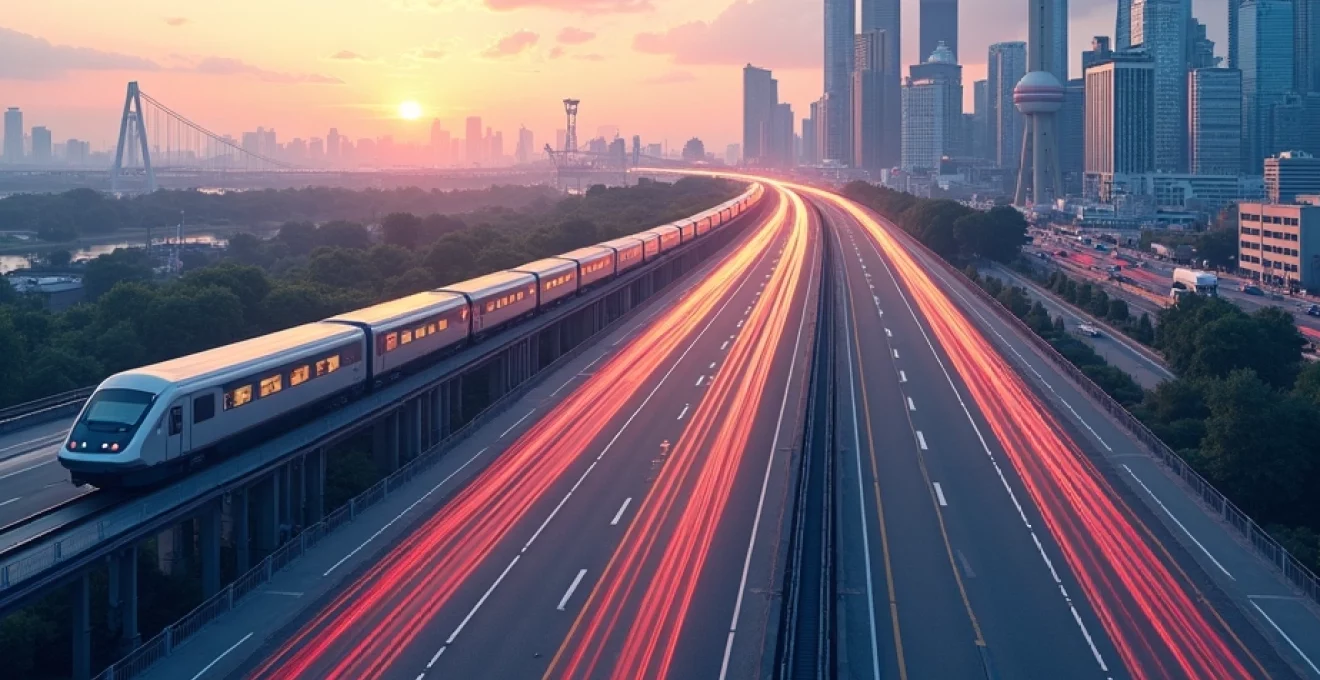
The landscape of global transportation is undergoing a revolutionary transformation, driven by cutting-edge technologies and innovative infrastructure solutions. As cities expand and economies become increasingly interconnected, the demand for efficient, sustainable, and accessible transportation systems has never been greater. From high-speed rail networks spanning continents to urban cable cars gliding above congested streets, modern transportation infrastructures are reshaping how we move and connect in the 21st century.
These advancements are not just about speed and convenience; they’re fundamentally altering the fabric of our societies, economies, and urban environments. By bridging vast distances and overcoming geographical barriers, new transportation infrastructures are opening up unprecedented opportunities for trade, cultural exchange, and personal mobility. Let’s explore how these innovative solutions are revolutionizing connectivity and accessibility on a global scale.
High-speed rail networks expand across continents
High-speed rail (HSR) networks have emerged as a game-changer in long-distance travel, offering a compelling alternative to air and road transportation. These advanced rail systems are not only reducing travel times between major cities but also fostering economic growth and regional integration. With speeds exceeding 250 km/h (155 mph), high-speed trains are redefining the concept of intercity connectivity.
Bullet trains revolutionize intercity travel
Bullet trains, first introduced in Japan with the Shinkansen network, have set new standards for speed, safety, and reliability in rail travel. These sleek, aerodynamic trains can reach speeds of up to 320 km/h (200 mph), dramatically reducing travel times between major urban centers. For example, the journey from Tokyo to Osaka, once a grueling 6-hour trip, now takes just 2 hours and 22 minutes on the Tokaido Shinkansen.
The success of bullet trains has inspired similar projects worldwide. China has built the world’s largest high-speed rail network, spanning over 38,000 km (23,600 miles) as of 2021. In Europe, countries like France, Spain, and Germany have extensive HSR networks, with the Eurostar connecting London to Paris in just 2 hours and 16 minutes through the Channel Tunnel.
Maglev technology promises even faster journeys
Magnetic levitation (maglev) technology represents the next frontier in high-speed rail. By using powerful electromagnets to levitate and propel trains, maglev systems eliminate wheel friction, allowing for even higher speeds. The Shanghai Maglev, operating since 2004, can reach speeds of 431 km/h (268 mph), making it the world’s fastest commercial train service.
Japan is currently developing the Chuo Shinkansen, a maglev line that will connect Tokyo and Nagoya in just 40 minutes, less than half the time of the current bullet train. When completed, this line will feature trains capable of reaching speeds up to 505 km/h (314 mph), setting new benchmarks for ground transportation.
Rail links airports cities economic hubs
High-speed rail is increasingly being integrated with other transportation modes, particularly airports, to create seamless travel experiences. Airport express services, such as Hong Kong’s Airport Express or London’s Heathrow Express, provide fast, direct connections between city centers and major international airports.
These rail links not only enhance accessibility for travelers but also contribute to the development of economic corridors. By connecting airports, cities, and industrial zones, HSR networks facilitate business travel, stimulate regional development, and create new opportunities for commerce and tourism.
Smart roads pave way for autonomous vehicles
As we move towards a future of autonomous vehicles, the concept of “smart roads” is gaining traction. These intelligent infrastructure systems integrate advanced technologies to enhance safety, efficiency, and sustainability in road transportation. Smart roads are designed to communicate with vehicles, collect and analyze traffic data in real-time, and adapt to changing conditions.
Key features of smart road technologies include:
- Embedded sensors for traffic monitoring and road condition assessment
- Dynamic traffic management systems that adjust speed limits and lane configurations
- Vehicle-to-infrastructure (V2I) communication for real-time information exchange
- Solar-powered road surfaces that generate electricity and melt snow
- Self-healing materials that repair minor cracks and potholes automatically
These innovations are paving the way for safer, more efficient transportation networks that can support the widespread adoption of autonomous vehicles. For instance, the Smart Road project in Virginia, USA, serves as a testbed for emerging transportation technologies, allowing researchers to evaluate the performance of autonomous vehicles in various weather and traffic conditions.
Smart roads are not just about accommodating new vehicle technologies; they’re about creating a more responsive, adaptive, and sustainable transportation ecosystem that can evolve with our changing mobility needs.
Urban cable cars offer innovative mobility solutions
In densely populated urban areas where traditional ground-based transportation faces challenges, aerial cable car systems are emerging as an innovative and cost-effective mobility solution. These systems offer a unique way to navigate complex urban landscapes, providing efficient transportation while minimizing the impact on existing infrastructure.
Gondolas glide above congested city streets
Urban gondola systems, such as the Metrocable in Medellín, Colombia, and the Emirates Air Line in London, demonstrate the potential of aerial transportation in cities. These systems can traverse difficult terrain, cross rivers, and bypass congested streets, offering a reliable and efficient alternative to buses or cars.
The benefits of urban gondolas include:
- Low environmental impact and energy consumption
- Ability to operate in various weather conditions
- Reduced need for land acquisition and infrastructure disruption
- High passenger capacity and frequency of service
- Potential for integration with existing public transit networks
Cities like La Paz, Bolivia, have embraced cable cars as a primary mode of public transportation, with the Mi Teleférico system serving as the world’s largest urban cable car network, carrying over 300,000 passengers daily.
Aerial trams connect hillside neighborhoods efficiently
For cities built on hilly terrain, aerial trams offer an efficient way to connect neighborhoods at different elevations. The Portland Aerial Tram in Oregon, USA, is a prime example, linking the South Waterfront district with the Oregon Health & Science University campus atop Marquam Hill. This 1,000-meter (3,300 ft) journey takes just four minutes, providing a crucial transportation link for thousands of commuters daily.
Aerial trams not only improve accessibility but also offer stunning panoramic views, potentially boosting tourism and enhancing the urban experience for residents and visitors alike.
Funiculars climb steep slopes with ease
Funicular railways, which use cable traction to move vehicles up and down steep slopes, have been serving cities for over a century. Modern funiculars continue to play a vital role in urban mobility, especially in cities with significant elevation changes.
Notable examples include:
- The Petrin Funicular in Prague, Czech Republic
- The Peak Tram in Hong Kong
- The Funiculì Funiculà in Naples, Italy
These systems not only provide essential transportation services but often become iconic attractions in their own right, contributing to the unique character of their respective cities.
Hyperloop systems promise Ultra-Fast ground transportation
Hyperloop technology represents a bold vision for the future of ground transportation, promising to revolutionize long-distance travel with speeds comparable to air travel but with potentially lower environmental impact and energy consumption.
Vacuum tubes propel passenger pods swiftly
The core concept of Hyperloop involves propelling passenger or cargo pods through low-pressure tubes at extremely high speeds. By creating a near-vacuum environment within the tubes, air resistance is dramatically reduced, allowing the pods to reach velocities of up to 1,200 km/h (745 mph).
Key components of Hyperloop systems include:
- Low-pressure tubes to minimize air resistance
- Aerodynamic pods for passenger or cargo transport
- Advanced propulsion systems, often using linear induction motors
- Magnetic levitation to eliminate friction between the pod and tube
- Solar panels to power the system, enhancing sustainability
Magnetic levitation enables frictionless high speeds
Magnetic levitation (maglev) technology is a crucial element in many Hyperloop designs. By using powerful electromagnets to levitate the pods above the track, maglev systems eliminate wheel friction, allowing for smoother acceleration and higher top speeds. This frictionless travel not only enables unprecedented velocities but also reduces wear and tear on the system, potentially lowering maintenance costs.
Hyperloop represents a paradigm shift in transportation, combining the speed of air travel with the convenience of ground transport, all while aiming for greater energy efficiency and reduced environmental impact.
Private companies race to deploy hyperloops
Several private companies and startups are actively developing Hyperloop technologies, each with their own unique approach. Virgin Hyperloop, for example, successfully conducted its first passenger test in November 2020, accelerating two passengers to 172 km/h (107 mph) in a 500-meter test tube in Nevada, USA.
Other notable players in the Hyperloop race include:
- Hyperloop Transportation Technologies (HTT)
- TransPod
- Hardt Hyperloop
- Zeleros Hyperloop
While full-scale Hyperloop systems are still in development, several countries have expressed interest in implementing this technology. For instance, India has announced plans to build a Hyperloop line between Mumbai and Pune, potentially reducing travel time between the two cities from 3-4 hours to just 25 minutes.
Intermodal hubs seamlessly integrate transport modes
As transportation networks become more complex and diverse, the need for efficient intermodal hubs has become increasingly important. These hubs serve as critical junctions where different modes of transport converge, allowing passengers to seamlessly transfer between various systems.
Modern intermodal hubs are designed to integrate:
- High-speed rail and conventional rail services
- Metro and light rail systems
- Bus rapid transit (BRT) and local bus services
- Airports and airport express trains
- Bicycle sharing systems and pedestrian walkways
Examples of successful intermodal hubs include Berlin Hauptbahnhof in Germany, which combines long-distance and regional rail with metro and tram services, and Hong Kong’s International Airport, which seamlessly connects air travel with high-speed rail, metro, and bus services.
The benefits of well-designed intermodal hubs extend beyond transportation efficiency. These facilities often become catalysts for urban development, attracting businesses, retail, and residential projects. By concentrating diverse transportation options in a single location, intermodal hubs can reduce travel times, improve accessibility, and encourage the use of public transit.
As cities continue to grow and evolve, the role of intermodal hubs in shaping urban mobility and development will only become more critical. These hubs represent the convergence of various transportation innovations, from high-speed rail to urban cable cars, creating a more connected and accessible future for cities worldwide.
The rapid advancement of transportation infrastructures is reshaping our world, bringing people and places closer together in ways previously unimaginable. From bullet trains crossing continents to urban cable cars soaring above city streets, these innovations are not just about moving faster – they’re about creating more accessible, sustainable, and interconnected societies. As we look to the future, the continued development of smart, efficient, and integrated transportation systems will play a crucial role in addressing the challenges of urbanization, economic growth, and environmental sustainability.